

Why Volleyball Players Tape Their Fingers
Volleyball players tape their fingers to support vulnerable joints, limit painful bending, and protect skin and nails during ball contact and dives. Some also use tape while returning from a minor sprain, after a clinician has checked the injury. Tape can add support, but it cannot prevent every jam or make an injured finger safe to play on.
A block can drive a ball into an outstretched finger; a dive can force it against the court. The right taping method depends on what the player needs to protect without losing the movement needed to play.
I'm Josh Key, and I've helped test and demonstrate SHIELD's performance and recovery products with athletes across the country. That experience informs how I answer "why do volleyball players tape their fingers?": start with the purpose, then choose a safe way to tape.
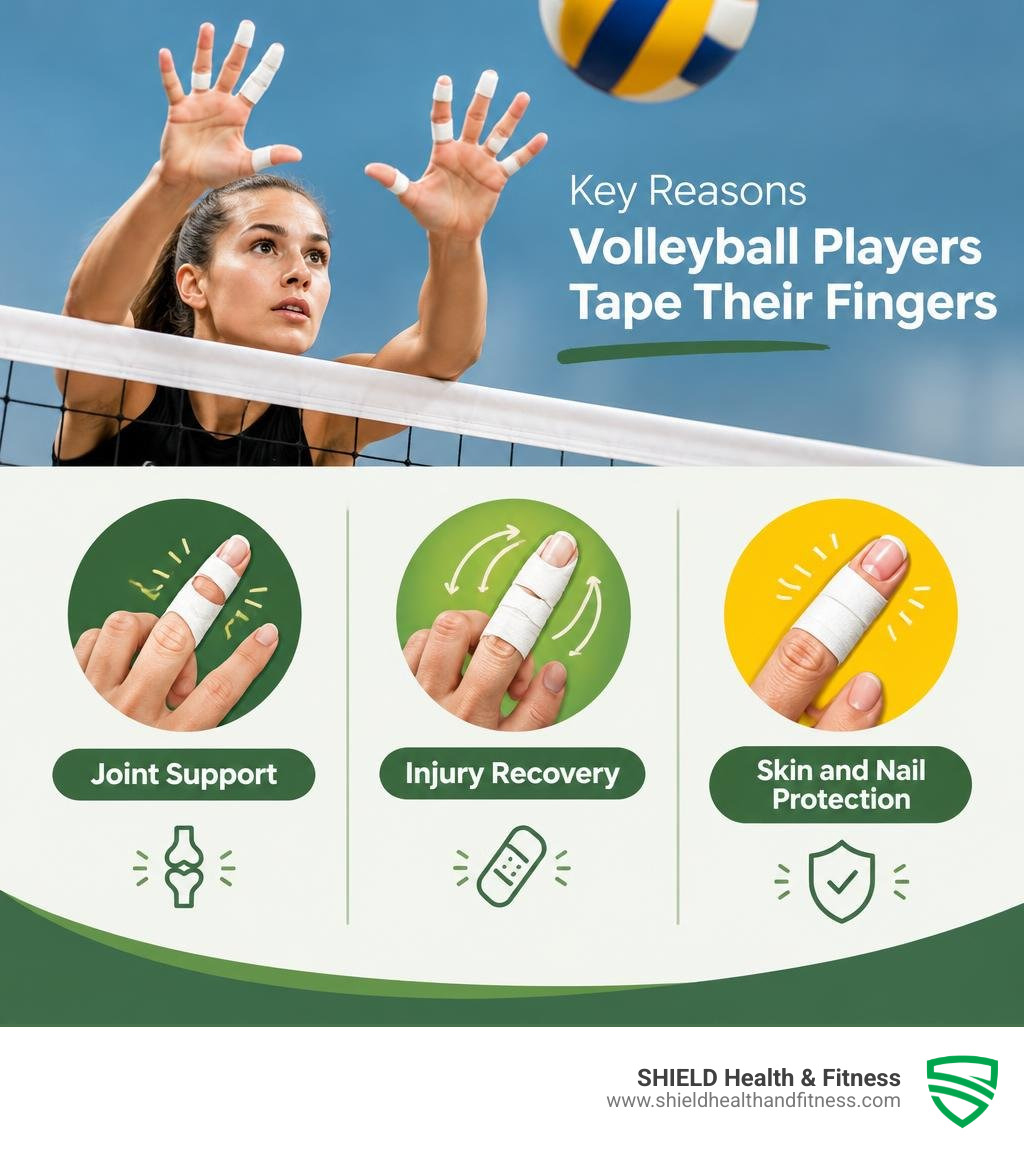
Biomechanics and Protection: Why Do Volleyball Players Tape Their Fingers?
Volleyball demands explosive power, pinpoint accuracy, and fearless defense. When we look at court mechanics, the hand absorbs an astonishing amount of punishment. Peak blocking forces can exceed 500 to 1,000 Newtons—equivalent to a 100-pound weight slamming directly into your extended fingertips in a fraction of a second. Spikes frequently cross the net at speeds between 70 and 75 mph.
When you consider understanding finger anatomy and biomechanical strain, it is easy to see why the hands take such a beating. Upper body trauma accounts for 20% to 30% of all volleyball injuries. Specifically, finger injuries make up about 13.4% of all acute court trauma, ranking third behind ankle (31.9%) and knee (17.4%) issues. According to the American Academy of Pediatrics clinical guidelines on volleyball injuries, 43% of upper extremity injuries in young athletes involve the fingers. Among those, 42.6% are sprains or strains and 19.5% are fractures. Over 57% of all fractures in the sport occur in the digits.
The proximal interphalangeal (PIP) joint—the middle knuckle—bears the brunt of this trauma, accounting for roughly 24% of all adult dislocations. Let's look closer at why players wrap up before stepping onto the hardwood.
Why Volleyball Players Tape Their Fingers for Blocking and Impact Defense
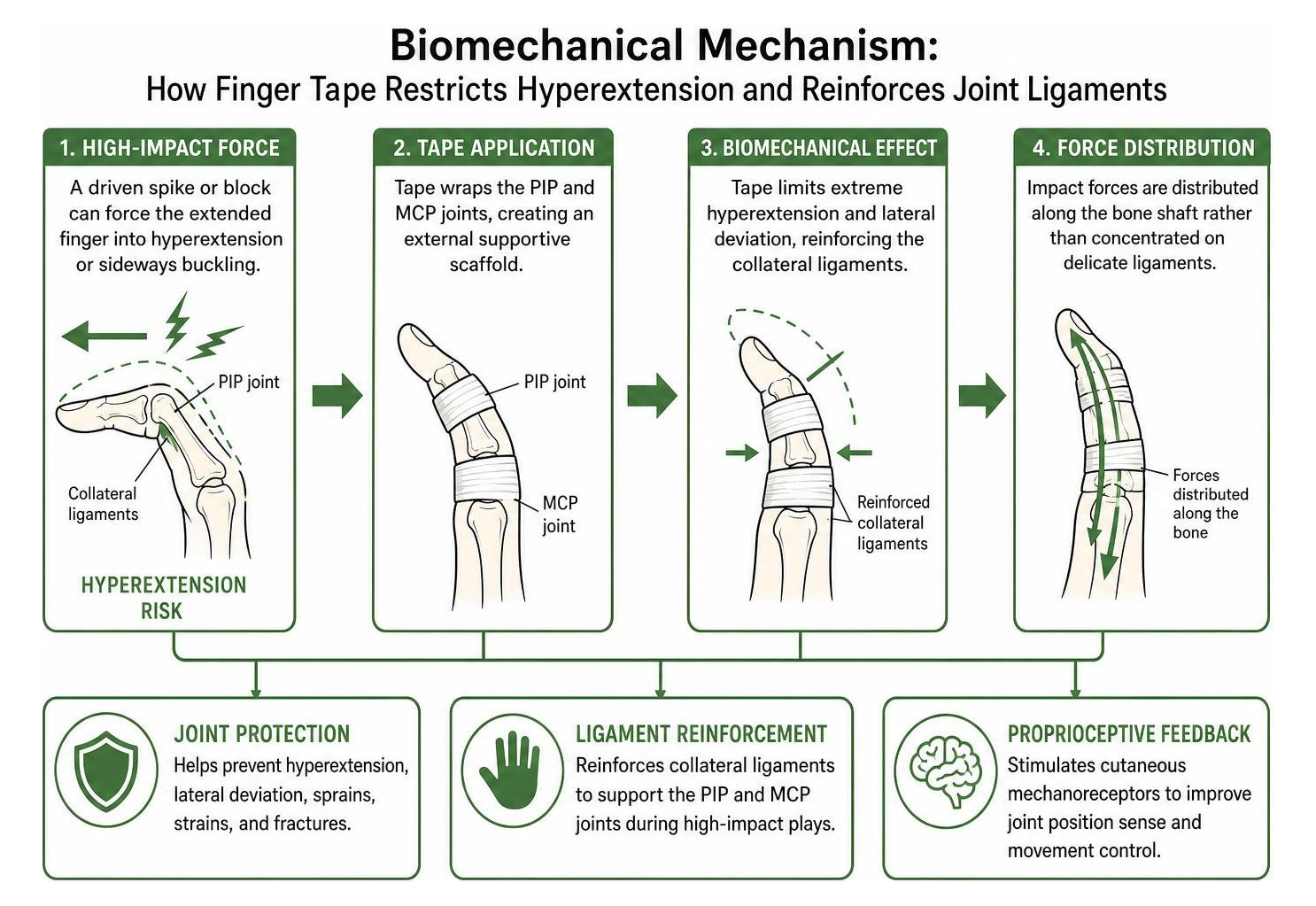
Front-row defenders face immense kinetic energy every time they press over the net. When a driven spike strikes an unbraced, extended fingertip, the force can easily overcome the natural tensile capacity of the collateral ligaments. This sudden force drives the joint into severe hyperextension or sideways buckling.
Taping acts as an external supportive scaffold. While tape cannot absorb every ounce of shock, it physically limits extreme lateral deviation and prevents hyperextension. By wrapping the PIP and metacarpophalangeal (MCP) joints, we reinforce the collateral ligaments, distributing high-speed impact forces evenly along the bone shaft rather than concentrating them on delicate connective tissue.
Why Volleyball Players Tape Their Fingers to Improve Grip and Skin Health
Joint defense is only half the battle. Modern indoor composite and leather volleyballs, paired with aggressive multi-match tournament play, wreak havoc on delicate skin. Repetitive friction strips natural moisture, leading to painful skin fissures and calluses that crack open during play.
A thin, snug layer of tape provides a protective barrier against micro-abrasions and prevents split fingertips. Additionally, dynamic fingertip taping secures the distal interphalangeal (DIP) joint and shields the nail bed, keeping nails from splitting or catching on floor mats during diving digs. Snug tape on the finger pads can also provide consistent friction when hands become slick with sweat during deep five-set matches.
Proprioceptive Feedback and Psychological Readiness
Beyond mechanical bracing, strategic wrapping delivers a measurable neuromuscular advantage. Scientific reviews of athletic taping demonstrate that tape application stimulates cutaneous mechanoreceptors in the skin. This sensory input improves joint position sense—known as proprioception—which helps players instinctively position their hands along safe anatomical lines during high-velocity plays.
There is also a genuine psychological component. Knowing your joints are securely wrapped gives you the mental confidence to swing aggressively, press deeply over the net, and dive without hesitation.
Essential Finger Taping Techniques for Court Performance
Applying athletic tape effectively is a skill every competitive athlete, coach, and trainer should master. Knowing how to tape fingers for volleyball before you play ensures your joints are braced without cutting off circulation or losing range of motion. Applying proper finger tape strategies for hand protection keeps your hands ready for match point.
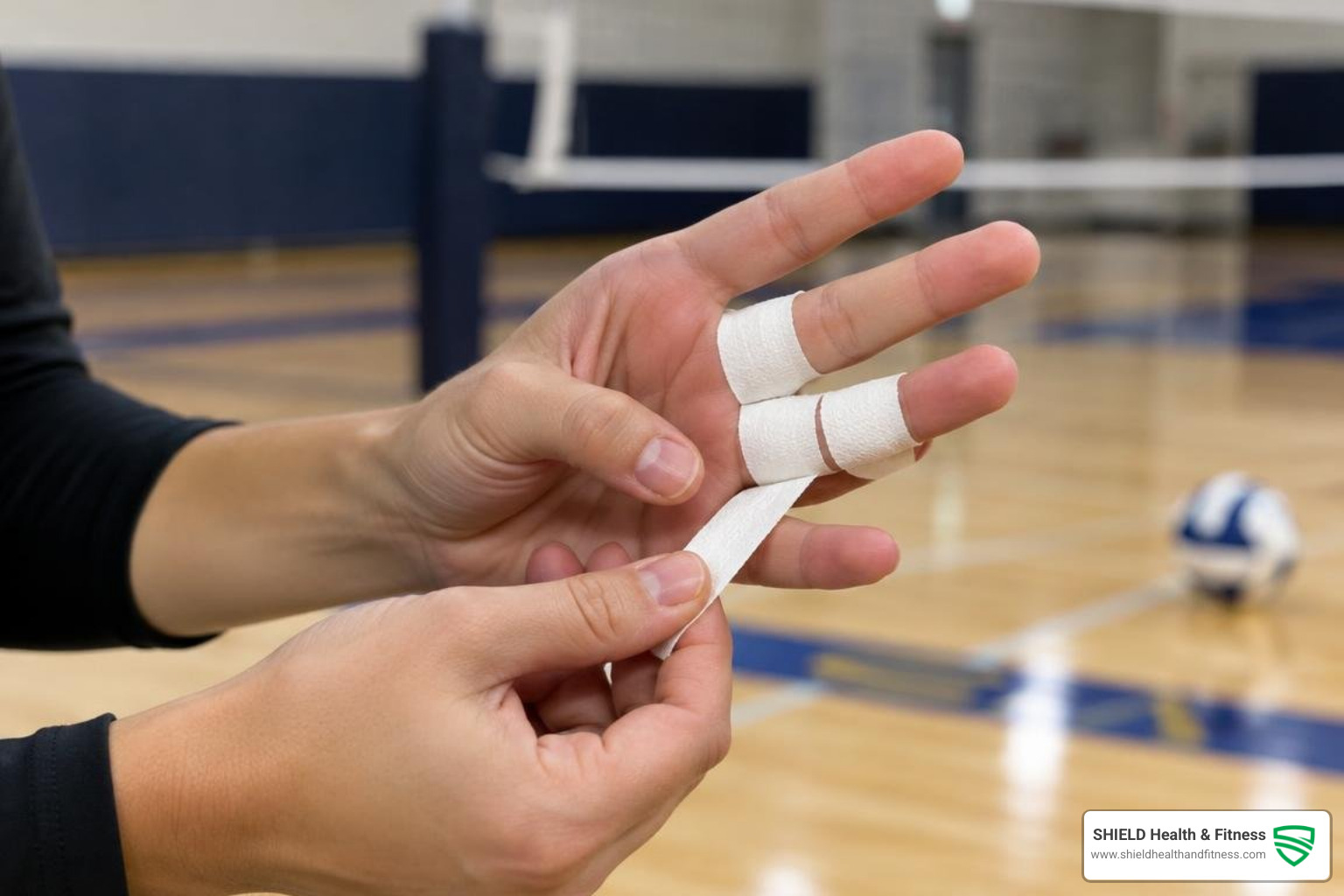
The Buddy Taping Method for Sprains and Jammed Digits
Buddy taping uses an adjacent healthy digit as an anatomical splint to stabilize a jammed or recovering finger. It is the gold standard for managing minor collateral ligament sprains.
- Prepare the skin: Clean and thoroughly dry both fingers to ensure optimal adhesion.
- Insert interdigital padding: Always place a thin piece of folded sterile gauze or foam padding between the two fingers. This prevents skin-on-skin friction, moisture buildup, and painful maceration.
- Anchor the base: Wrap a strip of 1-inch or 0.5-inch tape around the base of both fingers, below the PIP joint. Wrap 2 to 3 times with moderate tension.
- Secure above the joint: Wrap a second strip between the PIP and DIP joints, leaving the middle knuckle clear.
- Check joint mobility: Ensure there is a slight gap (around 1/4 inch) so the fingers can bend naturally into a loose fist while staying protected against lateral twisting.
The Knuckle X-Wrap for Hyperextension Defense
For individual fingers that need dedicated protection against backward bending during blocking, the cruciate X-wrap is ideal:
- Place anchor strips: Apply one horizontal anchor wrap around the phalanx below the PIP joint, and another anchor strip above the PIP joint.
- Form the support cross: Take a narrow strip of tape and route it diagonally from the lower anchor across the palmar (front) side of the knuckle to the upper anchor.
- Complete the X: Lay a second diagonal strip crossing over the first to create a secure "X" pattern directly over the palmar aspect of the joint.
- Lock it down: Finish with one circular anchor strip over the top and bottom bands to seal the ends cleanly. This allows full forward flexion while providing a physical backstop against backward hyperextension.
Fingertip and Nail Protection Wrapping
To protect cracked skin, prevent split nails, or manage DIP joint strain:
- Anchor on the pad: Place the end of a flexible tape strip on the palmar pad below the DIP joint.
- Fold over the nail: Pull the strip smoothly over the fingertip, across the nail, and down to the first knuckle on the dorsal side.
- Spiral lock: Secure the vertical piece by applying a circumferential spiral wrap from the base of the nail downward, decreasing tension as you wrap to prevent pinching the tip.
Position-Specific Taping Strategies: Setters, Blockers, and Hitters
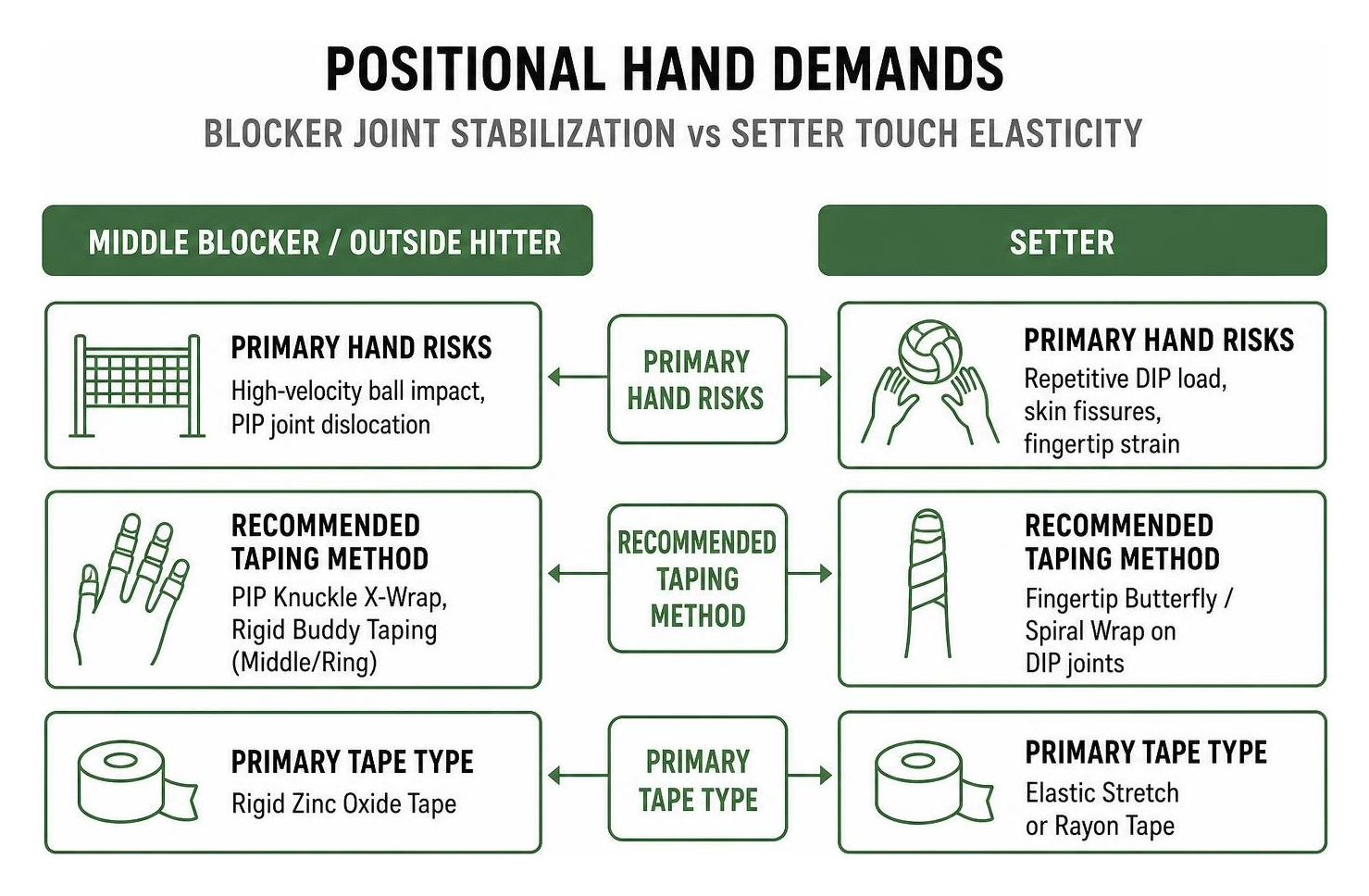
Different court positions place distinct biomechanical demands on the hands. Reviewing core hand taping techniques for court athletes can help you tailor your setup to your exact role.
| Volleyball Position | Primary Hand Risks | Recommended Taping Method | Primary Tape Type |
|---|---|---|---|
| Middle Blocker | High-velocity ball impact, PIP joint dislocation | PIP Knuckle X-Wrap, Rigid Buddy Taping (Middle/Ring) | Rigid Zinc Oxide Tape |
| Outside Hitter | Net contact, ball torque, hyperextension | X-Wrap on Index/Middle fingers, thumb anchor | Rigid or Rayon Tape |
| Setter | Repetitive DIP load, skin fissures, fingertip strain | Fingertip Butterfly / Spiral Wrap on DIP joints | Elastic Stretch or Rayon Tape |
| Libero / DS | Floor impact during dives, thumb UCL sprains | Thumb V-Anchor Spica, Fingertip abrasion wraps | Cohesive Wrap & Elastic Tape |
Middle Blockers and Outside Hitters: Maximizing Impact Resistance
Front-row hitters and blockers absorb the greatest forces at the net. Middle blockers frequently tape their index and ring fingers using rigid zinc oxide tape to brace the PIP joints against heavy spikes. Buddy taping the ring finger to the middle finger gives hitters a sturdy base to handle hard hits without jamming digits on the net tape or opposing blocks.
Setters: Maintaining Touch and Micro-Mobility
Setters handle the ball on almost every rally, requiring maximum tactile sensitivity and finger flexibility. Setters rarely use rigid buddy taping on their primary setting digits because it limits the hand spread needed for a clean set.
Instead, setters apply light elastic stretch tape or rayon tape to the DIP joints. This supports the extensor tendons, prevents mallet finger, and shields the skin from peeling during intense, high-repetition practices.
Defensive Specialists and Liberos: Floor Contact Protection
Liberos and defensive specialists spend matches sprawling across the hardwood. Their primary risk is jamming fingers or catching thumbs against the floor. A modified thumb spica wrap using elastic stretch tape stabilizes the ulnar collateral ligament (UCL) of the thumb, preventing painful "skier's thumb" sprains during diving pancakes.
Selecting the Best Athletic Tape for Finger Protection
Having the right tape in your bag ensures your wraps hold up through long tournaments. Learn more with our ultimate athletic tape guide for volleyball and explore dedicated athletic tape for hands.

Rigid Zinc Oxide Tape vs. Elastic Stretch Tape
Not all athletic tapes perform the same way under court stress:
- Rigid Zinc Oxide Tape: Made with high-tensile cotton and a strong adhesive, rigid tape does not stretch. It is ideal for structural bracing, buddy taping, and locking down joints against extreme force. For maximum joint defense, Shield 1-inch precision athletic tape gives players the clean tears and joint rigidity needed for high-impact blocking.
- Elastic Stretch Tape: Engineered to stretch and recover, elastic tape expands with natural joint movement. It provides dynamic support and proprioceptive feedback without locking out joint mobility. Shield Reflex stretch athletic tape tears easily by hand and provides flexible joint stabilization that moves with your hand.
Rayon and Cohesive Wraps for High-Sweat Environments
In hot gymnasiums and long multi-match tournaments, sweat can cause standard adhesives to slide:
- Rayon Finger Tape: Rayon fibers offer exceptional tensile strength with a thinner, lighter profile than traditional cotton. Shield rayon finger tape features an ultra-strong adhesive that resists sweat and friction during intense play.
- Cohesive Wraps: Self-adhering cohesive wraps stick only to themselves, not to skin or hair. They are breathable, gentle on sensitive skin, and easy to adjust between tournament matches.
Common Mistakes to Avoid and Medical Red Flags
Taping is an effective tool, but improper technique can cause problems on the court. Using dedicated volleyball athletic tape correctly protects both your joints and your circulation.
Overtight Application and Blood Flow Restriction
The most common taping mistake is wrapping too tightly around the digit. Finger arteries and veins run along the sides of each finger; excessive circumferential tension acts as a tourniquet.
Signs your tape is applied too tightly:
- The fingertip feels cold, throbs, or tingles.
- The nail bed turns pale, white, or deep purple.
- Capillary refill takes longer than 2 seconds (when pressing firmly on the nail bed, the pink color should return almost immediately).
If you experience any of these signs, remove the tape and reapply with lighter tension.
Competitive Rule Compliance (FIVB, USAV, and NCAA)
Governing bodies like the FIVB, USA Volleyball (USAV), and the NCAA maintain clear guidelines regarding court gear:
- Taping must be soft and pliable; rigid metal or hard plastic splints are strictly prohibited on court.
- Tape must follow natural joint lines and cannot present a hazard to other players.
- While neutral white tape is standard, colored kinesiology and athletic tapes are generally permitted as long as they are applied smoothly without loose, peeling ends.
When to See a Doctor Instead of Taping
Taping is designed for prevention and minor sprain recovery—not as a substitute for medical treatment.
Seek immediate medical attention if you notice:
- Visible joint deformity, crooked alignment, or bone displacement.
- Inability to actively bend or straighten the finger joint (a potential tendon avulsion, such as mallet finger).
- Severe, rapid swelling accompanied by dark bruising.
- Numbness that persists after removing all tape.
- Intense pain directly over the bone shaft rather than the joint ligament.
Frequently Asked Questions About Volleyball Finger Taping
Is finger taping legal in official FIVB and USAV competitions?
Yes. Finger taping is fully legal under FIVB, USAV, and NCAA regulations. The tape must be pliable athletic tape and cannot contain rigid components like metal or hard plastic splints that could injure opponents at the net.
How often should a player re-tape their fingers during a match?
Most players re-tape once or twice during a long five-set match, or between tournament rounds. Sweat, friction, and ball contact can gradually loosen tape adhesives. Inspect your tape during set intervals and reapply if edges begin rolling or joint tension loosens.
Does finger taping weaken joint muscles over time?
When used correctly during intense play, taping does not weaken hand muscles. The muscles that control finger flexion and extension reside primarily in the forearm. Taping supports passive joint structures (ligaments and joint capsules). However, players should combine game-day taping with regular hand strengthening and grip mobility exercises during off-court training.
Protect Your Hands and Elevate Your Game
Strategic finger taping gives volleyball athletes the confidence to block aggressively, set cleanly, and dive fearlessly. By matching the right taping technique to your court position and using premium, American-made athletic tape, you can keep minor sprains and skin splits from sidelining your season.
Explore our full line of professional-grade court wraps in the SHIELD Volleyball Collection and step onto the court fully protected for match point.